
A fear of spiders is one of the most common phobias that people have (technical term: arachnophobia). Even normally fearless individuals can be reduced to quivering wrecks by the sight of a tiny house spider lurking in the bathtub, and even those of us who don’t have a terror of all things eight-legged would admit that it’s pretty unnerving to see a spider dangle from a web right in front of your face or scuttle across your bed.

So it’s little surprise that filmmakers have long used spiders, big and small, to terrify audiences. Even the mention of the word has often been enough – many spy thrillers and serials from the twenties to the fifties had villains who were known as ‘the spider’, and the word still conjures up images of dark, sinister figures in films such as Along Came a Spider. The term was also applied to femme fatales, whose seductive techniques of ensnaring men were seen as similar to the way spiders catch flies. Some, such as the 1947 spy movie The Black Widow, were a mix of both styles.
As early as 1920, in Doctor Jekyll and Mr. Hyde, John Barrymore was assailed by a bizarre spider-man creature in his bed:
In 1943, Sherlock Holmes battled the sinister seductress Gayle Sondergaard in The Spider Woman, and the villainess was popular enough to be revived in a sequel, The Spider Woman Strikes Back.

This follow-up was, in fact, something of a cheat: although Gayle Sondergaard returned, her character was an entirely different one to that which pitted wits against Basil Rathbone’s Holmes, and the film is a simplistic and uneventful horror filler, with evil Zenobia (Sondergaard) feeding blood to mysterious plants.

All these ‘spider’ movies were notable for their lack of arachnid action. It wasn’t until the 1950s before the scary potential of the spider would be realised, and even then, it was in the form of the giant monster. The Fifties were the heyday of overblown nature gone berserk, usually as a result of radioactive mutation. We had giant ants in Them!, a giant octopus in It Came From Beneath the Sea, and even giant grasshoppers in Beginning of the End!

Giant spiders on the moon (now there’s a potential movie title!) threatened the astronauts who eventually encountered the Cat-Women of the Moon (1953). Amazingly, this cheapie spawned an even cheaper remake in 1958, Missile to the Moon.

A year later, arachnids controlled by Killers from Space made a brief appearance in the talky movie of the same title but one of the screen’s most memorable mutant monsters was about to arrive: Tarantula, shot by Jack Arnold.

The film follows the standard plot line of the time: a giant tarantula is rampaging across a desert in America, and eventually invades a small town, where the army is called in to deal with the threat. The story also diversifies to feature the dangers of atomic research, a scientist Leo G. Carroll’s experiments go wrong, resulting in hideous human mutations.

Also directed by Jack Arnold, The Incredible Shrinking Man is a 1957 sci-fi classic adapted for the screen by Richard Matheson from his novel The Shrinking Man.

In both the novel and the movie, the protagonist gets smaller and smaller and ends up battling with a cat that now seems giant-sized and, more significantly, a spider which now seems monstrous!

Not to be outdone, Bert I. Gordon – Mister B.I.G. – added The Spider to his roster of outsize creations which included The Amazing Colossal Man and sequel War of the Colossal Beast, Attack of the Puppet People. In The Spider – more commonly known as Earth vs The Spider, which is something of an exaggeration – the world’s oldest high school students stumble upon the lair of a giant tarantula while out searching for their missing father. The spider is killed by the local police… or so it seems. But while on display at the local school, it’s revived by the lamest rock ‘n’ roll band in history and runs amok. The film is pretty bad, even by Gordon’s unexacting standards, however, the title proved evocative enough to be used again in 2001.

Yet, the most outrageously camp spider movie of the decade was unquestionably the legendary Mesa of Lost Women, shot in 1952 by Herbert Tevos (as Tarantula until the production ran out of funds) and continued in 1953 by exploitation master Ron Ormond. This jaw-droppingly bizarre film features astonishing narration by Lyle Talbot, a mind-numbing guitar soundtrack and a truly amazing story: Addams Family star Jackie Coogan plays a mad scientist who is creating a race of amazons – and gimpy, malformed men – by injecting his subjects with spider venom! With an eye-popping performance by Tandra Quinn as the exotic spider-woman Tarantella.

In 1958, even the English countryside wasn’t safe from giant centipedes, insects and an enlarged spider in The Strange World of Planet X aka Cosmic Monsters. These abominable critters were the result of meddling by a mad scientist whose evil experiments invited the visitation of an alien invader, almost as if The Day the Earth Stood Still stood again so soon.

Another film which combined scantily-clad dancing girls and spiders was the 1959 German production Horrors of Spider Island. On the face of it, this one has the lot: glamour girls stranded on a mysterious island a giant spider god, and a mutant spider monster, created after a man is bitten by the aforementioned giant spider and transformed into a three-toothed, hairy creature. This was originally a cheesecake offering – originally titled It’s Hot in Paradise – that focused on nylons rather than webs and monsters. Unfortunately, the re-edited tame US version is a disappointment.
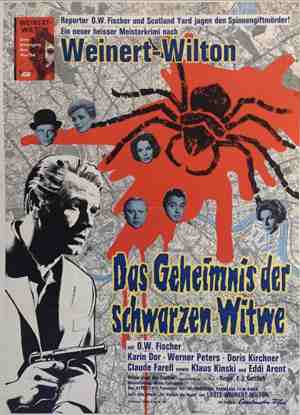
The Secret of the Black Widow is a 1963 krimi mystery thriller about an alcoholic journalist investigating strange murders. Someone is killing members of a South American expedition using poison darts with a rubber black widow spider attached to them!

Brazil’s controversial filmmaker José Mojica Marins’ first foray using his Coffin Joe character was in 1964. In At Midnight I’ll Take Your Soul, evil Joe kills his barren wife Lenita by tying her up and allowing a venomous spider to bite her.
 The wildest spider-themed film of the 1960s was undoubtedly Jack Hill’s magnificently eccentric Spider Baby. Shot in 1964, the film plays like a particularly demented take on The Addams Family. When two members of the Merrye family arrive at a large mansion to claim their inheritance, they meet a variety of oddball relatives kept in check by chauffeur Lon Chaney Jr. Amongst them is Virginia (Jill Banner), the ‘spider baby’ herself. Her fixation with spiders plays out in a remarkable, unsettling bawdy scene where she attempts to seduce her cousin Peter during a game of ‘spider’ – given that the rules of the game have him playing the fly, tied up in a ‘web’ while the ‘spider’ prepares her sting (to be provided by a couple of knives – it’s unsurprising that she has few willing playmates!
Unique, Spider Baby developed a growing cult following as it languished in obscurity during the 1980s and 1990s and was finally released on Blu-ray in Spring 2013. If you only buy one film mentioned in this feature, Spider Baby should be the one!

In Son of Godzilla (1967), a giant kaiju spider named Kumonga joined the ranks of Japanese studio Toho’s rack of monsters. He was back again in Destroy All Monsters (1968) but this time helping to save the world. Kumonga’s final, albeit brief, appearance was as one of the many ‘guest’ kaiju monsters in the 50th-anniversary movie Godzilla: Final War (2004).

Meanwhile, Brazilian filmmaker José Mojica Marins’ second Coffin Joe film This Night I’ll Possess Your Corpse (1967) features a scene in which one of the villain’s unfortunate female victims is tormented by several real tarantulas that crawl all over her sheer negligee!

One of the more risible scenes in British Hammer Film’s otherwise excellent Dennis Wheatley satanist novel adaptation, The Devil Rides Out (1968), was the attack of a superimposed giant spider.
For more spider movies please visit page 2
MOVIES & MANIA provides previews of new films, our own movie reviews/ratings, and links to other reviews from trustworthy recommended sources - all in one handy web location. Plus, links to legitimately watch 1000s OF MOVIES FREE ONLINE via platforms such as Amazon Prime, Plex, Roku, Tubi and on YouTube. As an Amazon Associate, we earn a very tiny amount from any qualifying purchases.
